
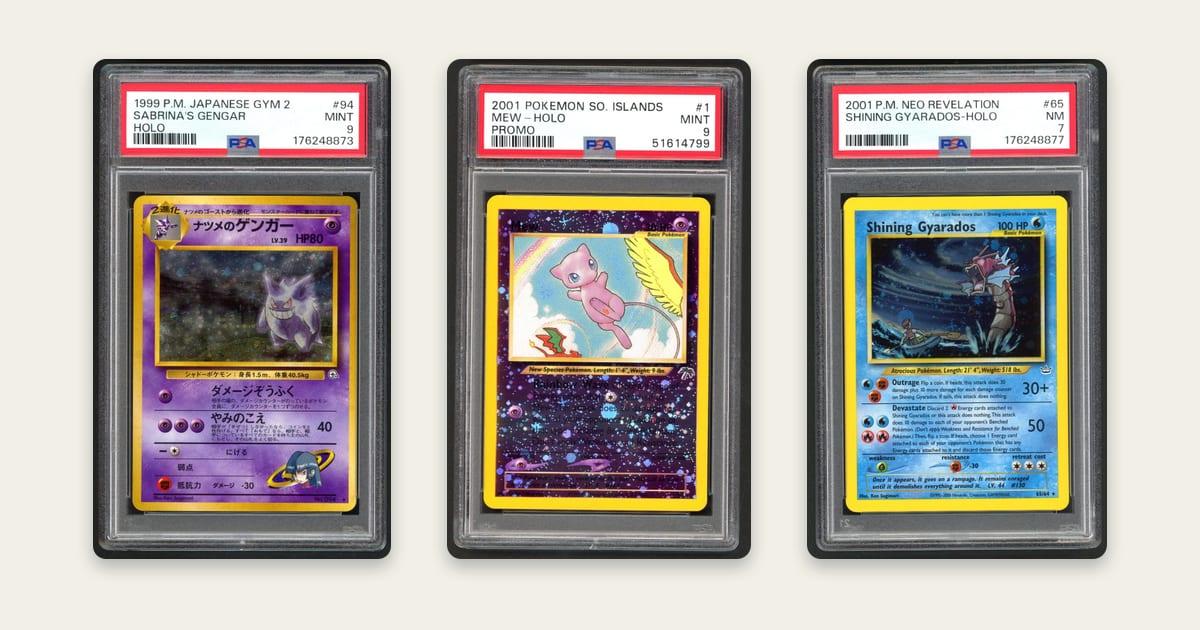
Store Pokemon cards in soft sleeves made of polypropylene, and put any card worth more than a few pounds into a rigid toploader or a semi-rigid holder as well. Keep them in a box or a binder somewhere cool, fairly dry, dark and steady all year round. In most homes that means a cupboard in a room you live in, never the loft, the garage or a damp spare room.
It matters because condition is most of what a card is worth. On PriceCharting's tracked sales on 25 November 2026, an ungraded 1999 Base Set Charizard averaged about $345, while copies graded 9 averaged about $2,121. The card is the same. What the buyer pays for is how well it has been kept. Good storage cannot improve a card, but it stops a card you have looked after from getting worse.
What damages a Pokemon card
Most damage comes from a handful of everyday things.
- Bending and creasing, from cards carried loose, held together with rubber bands, or squeezed into a binder that is too full.
- Wear on the corners and edges, which happens when bare cards rub against each other in a stack or a box.
- Scratches on the holo foil, the most visible fault on a shiny card.
- Damp, and swings in temperature and humidity, which make paper swell and shrink and can leave a card warped.
- Light, which fades colours over time.
- The wrong plastic, which can damage the card it is meant to protect.
A Pokemon card is printed card stock, so the people who look after paper for a living are the best guide. The Library of Congress advises keeping paper in a cool, relatively dry, clean and stable place, away from direct or strong light, and lists rubber bands, sticky tape and glue among the things not to use on it.
Sleeves, toploaders and semi-rigid holders
A penny sleeve, the thin soft sleeve most collectors use, is the first layer. It keeps fingerprints, dust and scratches off the card. Check what it is made of. The Northeast Document Conservation Center names three plastics that meet preservation standards, polypropylene, polyester and polyethylene, and warns that less stable plastics give off by-products as they age that speed up the breakdown of paper. Its guidance on photographs is blunter about PVC, which suppliers often sell as vinyl, calling it unacceptable for archival storage because it is not chemically stable. Many card sleeves say on the packet what they are made of, so look for polypropylene and avoid anything sold as PVC or vinyl.
The second layer is a rigid holder, for any card you would be sorry to see bent. A toploader is a stiff clear case the sleeved card slides into. A semi-rigid holder, often called a card saver, flexes slightly and is what grading companies such as CGC ask for when cards are sent to them. Either stops a card bending, which a sleeve on its own cannot do.
Slide the card in gently, top edge first, so the corners do not catch on the opening. If a card will not go in easily, the holder is the wrong size.
Binders and storage boxes
A binder is the easiest way to see a collection, and it is fine for cards worth a few pounds or less. Choose pages made of one of the stable plastics above, put one card in each pocket, and do not fill the binder so full that it will not close flat. Pressure from an overstuffed binder is the kind of slow bending that can show up later as a wavy card.
For anything more valuable, sleeved cards in toploaders or semi-rigid holders, stored upright in a box made for them, are safer than a binder. Fill any gaps in the box so the cards cannot slide around, and keep the box closed so light and dust stay out.
Two habits are worth breaking. Keep rubber bands away from the cards themselves, because a band pulled tight dents the edges of the cards at either end of the stack. And never leave a stack of bare cards loose in a drawer, where every movement rubs one surface against another.
Where to keep cards at home
The Library of Congress puts the right conditions for paper at around 35% to 50% relative humidity, at room temperature or below, away from radiators and vents, and it rules out attics and basements because of the risk of leaks and extremes. In a British home that means not the loft, the garage, the cellar or an outbuilding. A cupboard or a drawer in a heated room that people use every day is usually the steadiest place in the house.
If you want to know rather than guess, a small hygrometer from a hardware shop shows the humidity where the cards live. Whatever the reading, steadiness matters as much as the number. A room that is warm and dry in the day and cold and damp at night is harder on cards than one that stays a little too warm all year.
Keep cards out of direct sunlight, including the light that comes through a window onto a shelf. Cards on display get the most light, which is worth remembering before you frame a valuable one.
Storing graded slabs
A slab protects the card sealed inside it from handling, bending and dust, so most of the work is already done. The case itself is what needs looking after. Slabs scratch each other if they are stacked loose, and a scratched case is the first thing a buyer notices. Store them upright in a box, side by side, with soft padding between them if they are not in a box made for slabs.
The card inside is still paper, so the advice on light and damp still applies. Never open a slab to rehouse a card. Once the case is opened the grade no longer applies to the card, and the certificate number on the label stops describing anything in your hand.
Sealed booster packs and boxes
Unopened product is stored much like cards. Keep it flat or upright in a cool, dry, dark cupboard, away from anything that could crush the corners of a box or crease a pack. A sealed vintage booster pack sells as a sealed pack, and opening it turns it into a handful of single cards, so think hard before opening one you plan to sell.
Storage and selling
How a card has been stored decides how it can be sold. A card kept sleeved and flat since it came out of the pack is a candidate for grading, and grading only pays on cards in excellent condition. A card that spent years loose in a shoebox in the loft is far more likely to be worth selling as it is, or in a lot with others.
It also matters when the cards leave your home. Our terms insure cards while they are at our premises, but not damage that happened before they arrived or damage from poor packing, so cards that have been stored well should be packed for the post with the same care. Age, too, is less important than most people think, and old cards are not automatically worth more than new ones. The condition they have been kept in usually decides it.
Store cards as if you might sell them
Sleeve every card worth keeping, put the valuable ones in a rigid holder, and keep them somewhere cool, dry, dark and steady. None of it is expensive, and all of it protects the one thing that sets a card's price that you can control. When the time does come to sell, we can sell your Pokemon cards for you on our eBay store, and Lake Card Store can tell you which of your cards are worth selling on their own and which route suits each one.