
Grading a Pokemon card is worth it when the price it is likely to fetch in a slab beats its raw price by more than the grading fee, the postage both ways and the months you will wait. In practice that means cards that are already valuable and in excellent condition. For most cards it is not worth it, and a disappointing grade can leave a card worth less than it was before it went off.
How much value grading adds depends almost entirely on the grade that comes back. On PriceCharting's tracked sales on 22 October 2026, a 1999 Base Set Charizard averaged about $472 ungraded, $3,451 graded 9 and $18,163 as a PSA 10. An Umbreon VMAX alternate art from 2021 averaged about $1,725 ungraded and $3,750 as a PSA 10, while copies graded 7 averaged less than ungraded ones. It is the grade on the label that moves the price, not the slab itself.
What grading does to a Pokemon card
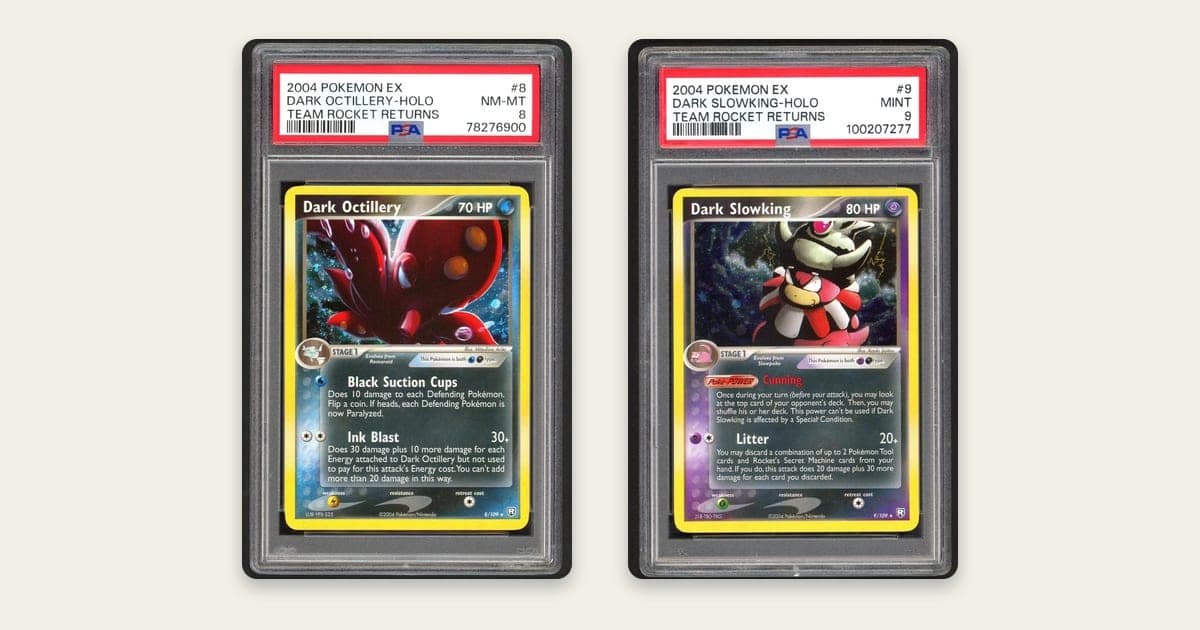
A grading company checks the card is genuine, judges its condition on a ten point scale, and seals it in a hard plastic case, known as a slab, with a label showing the card, the grade and a certificate number. The top grades are strict. PSA's Gem Mint 10 allows the artwork to sit no further off centre than roughly 55/45 on the front and 75/25 on the back, and CGC uses the same limits for its Gem Mint 10, with a stricter Pristine 10 above it.
What a buyer pays for is certainty. A raw card listed as near mint is the seller's opinion. A graded card has been looked at by someone with no stake in the sale, and its condition is fixed in writing.
How much value grading adds, in real sold prices
These are averages from PriceCharting, which tracks completed sales and quotes them in US dollars, as they stood on 22 October 2026. Its grade 7, 8 and 9 figures cover cards graded by PSA or Beckett, and its 10 figure here is PSA only. Some rest on very few sales. PriceCharting showed about one sale a month for the Charizard in a PSA 10 and for the Umbreon graded 7, so treat those two as a rough guide.
| Grade | 1999 Base Set Charizard | 2021 Umbreon VMAX alt art |
|---|---|---|
| Ungraded | $472 | $1,725 |
| Graded 7 | $824 | $1,669 |
| Graded 8 | $1,266 | $1,800 |
| Graded 9 | $3,451 | $2,100 |
| PSA 10 | $18,163 | $3,750 |
Three things stand out. The first is that the grade sets the price, not the act of grading. A 7 and a 10 of the same Charizard are worlds apart.
The second is that the old card gains far more from a top grade than the new one. The 1999 Charizard is worth nearly forty times as much as a PSA 10 as it is ungraded. The 2021 Umbreon is worth about twice as much.
The third is the warning. Umbreon copies graded 7 averaged less than ungraded ones, and copies graded 8 only about $75 more. A raw copy still leaves a buyer room to hope it is a 10, and a 7 on the label rules that out.
PriceCharting quotes its figures in US dollars, and UK prices for your card may be different. Use them for the pattern, then check what your own card has sold for here.
What grading costs from the UK
Prices change often, so check each company's own page before you send anything. As at 22 October 2026, this is what three grading companies charged a UK collector.
CGC takes submissions at its London office and prices them in pounds. Its Bulk service is £16.80 per card including VAT, for a minimum of 25 cards each worth up to £400, and its Standard service is £54 per card for cards worth up to £2,500. CGC's current turnaround is about 50 working days, and it says plainly that turnaround times are not guaranteed.
ACE, a company registered in England and Wales, prices in pounds too. Its Basic service is £18 per card with a 30 business day turnaround, Standard is £25 at 15 days and Premier is £32 at 10 days, with cheaper and slower tiers from £12 a card for members of its AceSelect scheme.
PSA paused its Value services in June 2026 to work through its backlog, and on 22 October 2026 its services page still listed them as paused. Its cheapest open service is Standard, at $59.99 per card, with an estimated 90 to 100 business days and a maximum insured value of $1,000. Priority is $79.99 with a $1,500 limit, and Express is $199 with a $2,500 limit and an estimated 20 to 30 business days. PSA has announced a receiving centre in the London area for 2026 and said it would share the address and launch details nearer the time, so check its site for whether it has opened. Until it does, PSA grading means your cards travel abroad, and a parcel coming back into the UK can carry VAT, duty and a handling charge that has to be paid before it is delivered.
Whichever company you use, add tracked and insured postage both ways, and the time your card spends away.
Run the sums before you send a card off
It is worth doing for every card before you pay to have it graded.
- Find what the card sells for raw. On eBay, completed listings show what items like yours have actually sold for.
- Find what it sells for at the grade you realistically expect, not the grade you hope for. Look at the corners, the edges, the surface under a bright light and the centring, and be strict.
- Take off the grading fee and the postage both ways.
- Compare what is left with the raw price. If grading only just comes out ahead at a 9 and loses money at an 8, the odds are against you.
The Umbreon shows how fine the margin can be. A copy graded 9 averaged about $375 more than an ungraded one, before fees, postage and import charges came out of that gap. A card worth $1,700 to $2,100 is over the $1,500 limit on PSA's Priority service, so it would go in at Express, $199 a card. That takes more than half of the gap before you have paid postage both ways, and if the card comes back an 8, the fee alone is more than the $75 an 8 adds.
Grading and our payout bands
If you plan to consign through us, there is one more effect worth knowing. The share you keep rises with the sale price. On our Standard rates you keep 85% of a sale under £100, 88% from £100, 90% from £1,000, 93% from £2,000 and 95% from £3,000. So a grade that lifts a card past one of those lines lifts your percentage as well as the price. Our own worked examples show the climb, with a £60 sale paying you £51, a £500 sale paying £440 and a £1,500 sale paying £1,350. The payout calculator does the sum for any price.
Grading fees work the other way. They cost the same whatever the card is worth, so they take a bigger bite out of a cheap card. CGC's £16.80 Bulk fee is 28% of the price of a £60 card, and under 6% of a £300 one.
Which Pokemon cards are worth grading
The cards most worth grading are the ones already worth real money, in condition you would bet on, where sold prices show a clear gap between the grade you expect and a raw copy. That usually means sought-after vintage holos in clean condition and modern chase cards that have gone straight from the pack into a sleeve. Our post on whether old Pokemon cards are worth more than new ones covers what makes a card sought after in the first place.
The cards least worth grading are those whose raw price is close to the fee, anything with visible wear such as whitened edges, creases or holo scratches, and modern cards where a 9 barely beats a raw copy.
Should you grade before you consign?
Not necessarily. We sell raw cards and graded slabs, and a raw card in good condition with clear recent sales can sell well as it is. Where grading does help, the route matters too. A strong grade fresh back from the grader is the kind of card our 10 day auctions suit best, because the bidding sets the price. A rarer slab with a steady sales record can sit at a Buy It Now price until the right collector finds it. If you are still deciding where to sell at all, our guide to where to sell Pokemon cards in the UK compares the options.
If you have run the sums and still cannot decide, tell Lake Card Store about the card and its condition. We will come back with the route we would use and what you could expect to receive selling it raw, which is the figure to set against the cost of grading it.