
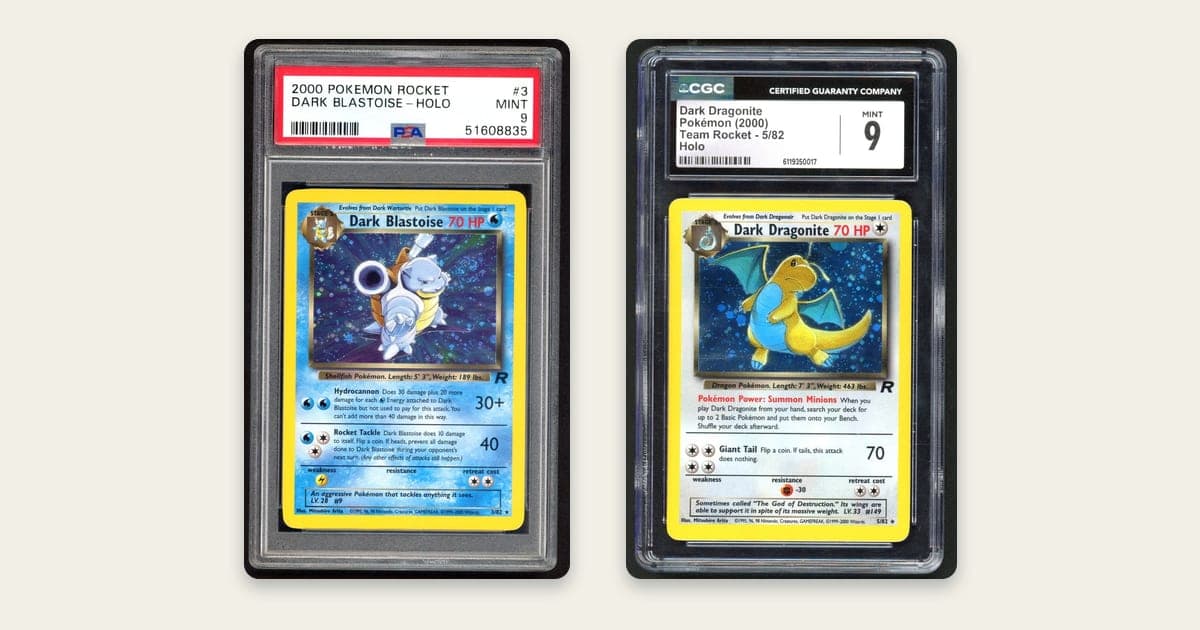
A PSA 10 usually sells for more than a CGC Gem Mint 10, often by a wide margin. CGC is cheaper and simpler to use from the UK, because it takes submissions at its London office and prices them in pounds. PSA charges in dollars, paused its cheaper services in June 2026, and until the London receiving centre it has announced opens, using it means sending your cards abroad. So for a card where a PSA 10 is the whole point, and you can wait, PSA is usually worth it. Where the fee and the turnaround matter more than the last slice of resale value, CGC, or ACE, a UK-registered grader, makes more sense.
The gap shows clearly in sold prices. On 22 October 2026, PriceCharting's tracked sales had a PSA 10 of the Charizard ex Special Illustration Rare from 2023's 151 set at about $1,285, against $579 for a CGC Gem Mint 10. A PSA 10 1st Edition Base Set Charizard was about $343,098, nearly eight times the $43,770 of a CGC 10, though PriceCharting records only about three sales a year of a PSA 10 of that card.
How the PSA and CGC grading scales compare
Both companies grade on a ten point scale, and at the top they are closer than the prices suggest. PSA's Gem Mint 10 allows the artwork to sit no further off centre than roughly 55/45 on the front and 75/25 on the back. CGC's Gem Mint 10 uses the same centring limits.
The difference is that CGC has a grade above its 10. A CGC Pristine 10 needs 50/50 centring and a card that is flawless under ten times magnification, and it comes with its own label. PSA has nothing above Gem Mint 10.
One detail matters if you buy or sell older CGC slabs. CGC changed its scale, and under its own key a slab labelled CGC Trading Cards Gem Mint 9.5 now counts as a CGC Cards Gem Mint 10. CGC's population report counts it that way too, so a buyer comparing an older CGC 9.5 with a newer CGC 10 is comparing the same grade.
What PSA and CGC slabs sell for
These are averages from PriceCharting, which tracks completed sales and quotes them in US dollars, as they stood on 22 October 2026. For both cards PriceCharting lists 30 recent sales behind each PSA 10, CGC Pristine 10 and CGC Gem Mint 10 figure.
| Slab | 2023 151 Charizard ex | 2021 Umbreon VMAX alt art |
|---|---|---|
| PSA 10 | $1,285 | $3,750 |
| CGC Pristine 10 | $1,813 | $4,330 |
| CGC Gem Mint 10 | $579 | $2,774 |
| ACE 10 | $835 | $2,854 |
A few patterns come through. A CGC Gem Mint 10 trailed a PSA 10 on every card we looked at, averaging about 45% of the PSA price on the 151 Charizard ex, about 74% on the Umbreon and about an eighth on the 1st Edition Charizard. The gap varies a great deal from card to card, and it was widest on the 1999 one.
A CGC Pristine 10 went the other way, averaging more than a PSA 10 on both modern cards. The catch is that you cannot ask for Pristine. CGC awards it, and only to cards that clear a stricter bar than a PSA 10 does.
ACE 10s sat between the two CGC grades on both modern cards, ahead of a CGC Gem Mint 10 and behind a PSA 10.
PriceCharting's figures are a guide to the pattern rather than a quote for your card. UK sale prices can differ, and the gap between companies varies from card to card, so check what your exact card has sold for in each type of slab before you choose.
What PSA and CGC cost from the UK
Fees and queues change often, so check both companies' own pages before you send anything. This is how they stood on 22 October 2026.
CGC takes submissions at its London office and prices in pounds. Its Bulk service is £16.80 per card including VAT, for at least 25 cards each worth up to £400. Standard is £54 a card for cards worth up to £2,500, and Express is £96 a card for cards worth up to £8,000. CGC's current turnaround is about 50 working days, which it describes as approximate and not guaranteed.
PSA paused its Value services in June 2026 while it worked through a backlog, and on 22 October 2026 its services page still listed them as paused. Since it reshaped its services on 14 September, its Standard service is $59.99 a card with a maximum insured value of $1,000 and an estimated 90 to 100 business days. Priority, the old Regular service, is $79.99 with a $1,500 limit, at 70 to 80 business days. Express is $199 with a $2,500 limit, at 20 to 30 business days, and Premier is $599 with a $10,000 limit, at 7 to 10 business days.
The bigger difference for a UK collector is getting the cards there and back. PSA began grading in Frankfurt in September 2026 for collectors in the European Union, and it has announced a receiving centre in the London area for UK collectors, planned for 2026, with the address and launch details still to come. Until that opens, PSA grading means sending your cards abroad, and when they come back the parcel can carry VAT, duty and a handling charge that you pay before it is delivered.
ACE, registered in England and Wales, charges £18 a card for 30 business days, £25 for 15 days and £32 for 10 days, with member tiers from £12 a card for members of its AceSelect scheme.
Which grading company to use for your cards
For valuable vintage that you believe is a genuine 10, PSA is usually the answer even at today's prices and waiting times. On the 1st Edition Charizard the difference between a PSA 10 and a CGC 10 ran to nearly $300,000, which dwarfs any fee.
For modern cards it comes down to two things, the price gap for that particular card and how sure you are of the grade. On the 151 Charizard ex, a PSA 10 averaged about $700 more than a CGC Gem Mint 10, which comfortably covers PSA's higher fee and the postage. On a card where the two slabs sell for similar money, or where a 10 is far from certain, CGC's £16.80 Bulk fee or ACE's £18 Basic fee, sent by domestic post and back sooner, leaves more in your pocket. Our post on whether grading is worth it at all walks through how to run those sums for a single card.
For a modern card you are confident is flawless, CGC's Pristine 10 outsold a PSA 10 on both modern examples above. That is a bet on the card, though. One that just misses Pristine comes back a Gem Mint 10 at best, the lowest priced 10 in the table.
Whichever you choose, base the decision on the card in front of you. A card worth sending to PSA is one whose PSA 10 price clearly beats what you would get from a CGC or ACE slab after fees, and whose condition gives it a real chance of the 10. If the card is old and you are not sure what makes it valuable, our post on whether old Pokemon cards are worth more than new ones covers what to look for first.
Selling a PSA or CGC slab through us
We sell slabs from more than one grading company for our consignors, alongside raw cards, so there is no need to pick a grader with us in mind when you consign with us. The label on the slab matters less to us than how to sell it. Fresh grades and chase cards suit our 10 day auctions, and low population slabs and higher end cards with a steady sales record suit Buy It Now. You can see the kind of slabs we sell in our eBay store.
If you are weighing up grading against selling now, or consigning against the other ways to sell, our guide to where to sell Pokemon cards in the UK compares the options. And if you already hold a PSA or CGC slab you want to sell, tell Lake Card Store the card, the grader and the grade, and we will come back with the route that suits it.